How do you get more Trustpilot reviews?
To get more Trustpilot reviews, send an automated review invitation to every customer on the same trigger event, at the same point in the journey. Add one reminder a few days later, invite your back catalogue across a 90-day window, and never stop the flow. Consistent volume, not one-off pushes, is what lifts a TrustScore.
- Claim and verify your Trustpilot business profile.
- Pick one trigger every customer reaches: order delivered, job completed, ticket closed.
- Automate the invitation with a native integration, the BCC-based Automatic Feedback Service, or the Invitations API.
- Turn on one reminder. Trustpilot reports reminders collect roughly 35% more reviews on average.
- Backfill 90 days of past customers to build baseline volume.
- Reply to everything, especially the one-stars, within 48 hours.
- Leave it running. Recency is weighted, so a profile that stops collecting slowly drifts back toward neutral.
Key takeaways
- Volume beats a perfect average. A 4.4 across 1,900 reviews outsells a 5.0 across 22, and it absorbs a bad week without moving.
- Invited and organic reviews weigh the same. Trustpilot states its calculation does not distinguish between verified, invited and unprompted reviews.
- Every profile starts with seven neutral 3.5★ reviews built into the calculation, which is why new profiles cannot show 5.0.
- Recency is weighted. A profile that stops collecting drifts back toward neutral as old reviews lose influence.
- Invite all customers or none. Selective inviting, review gating and incentives are prohibited, and are separately unlawful in the US, UK and EU.
- Automate on one trigger every customer reaches, then add a reminder. Trustpilot reports reminders collect around 35% more reviews.
- You cannot delete or pay to remove reviews. Your flagging record, including the share of flags found invalid, is published publicly.
Here is the uncomfortable arithmetic. If you serve a thousand customers a month and you're collecting eleven reviews, you don't have a reputation problem. You have a request problem. The reviews exist. They're sitting in the heads of people who liked what you did and were never asked to say so.
That gap is the entire opportunity, and it's why almost every "how do I fix my Trustpilot score" question has the same first answer: ask more people, more consistently, in a way that doesn't bias who answers.
This guide covers the whole system for how to get more Trustpilot reviews. It's long because the subject is operational, not inspirational. You'll find the invitation methods ranked, the maths behind the score, five templates you can paste today, the timing windows by business type, a reply framework for one-star reviews, and a 30-day plan. Everything here is inside Trustpilot's Guidelines for Businesses. Nothing here requires you to buy anything from anyone.
1. Why volume beats a perfect rating
Two stores. Store A has 22 reviews at a flawless 5.0. Store B has 1,900 reviews at 4.4. Ask a hundred shoppers which company they'd buy from and Store B wins, comfortably, every time.
This isn't sentiment. It's how people read risk. A perfect score on thin volume reads as unverified, or worse, as staged. A slightly imperfect score on heavy volume reads as a real company that has served enough people for the average to mean something. Trustpilot itself cites research from the Association for Psychological Science finding that people choose the product with more reviews over a similar product with a higher rating and fewer reviews.
Volume does something else that matters more operationally: it buys you insurance.
| Scenario | Profile with 40 recent reviews | Profile with 1,200 recent reviews |
|---|---|---|
| One bad week, five 1-star reviews | Score drops visibly, often 0.2–0.4 | Barely registers: hundredths of a point |
| Recovery time | Weeks of clean collection | Effectively immediate |
| What a shopper concludes | "Something's going wrong there" | "Every company has off days" |
Every business has a bad fortnight: a courier failure, a supplier delay, a product batch that shipped wrong. On a thin profile, that fortnight becomes your public rating for the next quarter. On a thick one, it's noise. Collecting steadily isn't vanity. It's the difference between one logistics failure costing you a season of conversion rate and costing you nothing at all.
2. How the TrustScore actually works (and three myths)
You cannot plan a review programme without understanding the scoring model, because the model is what makes some tactics work and others pointless. Trustpilot publishes the mechanics in its TrustScore documentation. Three factors drive it:
Factor one: recency
Newer reviews carry more weight than older ones, because they're a better signal of how you're performing now. A wall of five-stars from 2023 does less for you than a modest run from last month.
Factor two: frequency
Because recent reviews dominate, the score is most stable when reviews arrive regularly. A steady trickle produces a calmer, more defensible score than a quarterly blast. This is the single most under-appreciated mechanic on the platform, and it's the reason "campaigns" underperform "systems."
Factor three: the neutral anchor
Every profile starts with seven neutral 3.5-star reviews baked into the calculation. This is a Bayesian prior, and it's why a brand-new profile with two genuine 5-star reviews shows something in the high threes rather than a perfect 5.0. As real reviews accumulate, the anchor's influence fades.
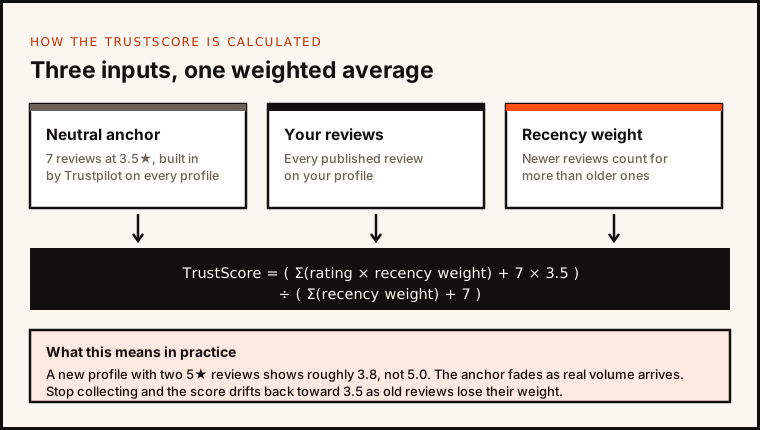
Two more mechanics worth knowing: for businesses under 10,000 reviews the TrustScore is recalculated immediately after each new review is posted. Above that threshold it recalculates once a day, since the number no longer moves quickly. The resulting score is then displayed as a star rating rounded to the nearest half or full star.
Do verified Trustpilot reviews count more than organic ones?
| The myth | What Trustpilot actually says |
|---|---|
| "Verified reviews are weighted more heavily than organic ones." | False. The calculation does not distinguish between verified, invited and unprompted reviews. Review source does not affect a review's weight. |
| "Paying for a Trustpilot subscription improves your score." | False. The calculation is identical for every business regardless of industry or whether they have a paid subscription. |
| "Old bad reviews will drag me down forever." | False. Time weighting means old reviews steadily lose influence. The flip side: old good reviews fade too, which is why stopping collection lets a score drift back toward neutral. |
That first myth is everywhere in SEO content about Trustpilot, and it's worth being precise about, because it changes strategy. If invited reviews were worth less, you'd chase organic ones. They aren't. So the correct play is to invite everybody, systematically, and let the source labels sort themselves out.
TrustScore projection calculator
Model what a batch of new reviews does to your score, including the seven-review neutral anchor.
Approximation using Trustpilot's published seven-review 3.5★ anchor. It doesn't model time decay or Trustpilot's undisclosed fraud adjustments, so treat it as a planning tool, not a promise.
3. The one rule that decides everything: invite all or none
If you take a single thing from this guide, take this. Trustpilot operates an "invite all customers or none" principle, and almost every enforcement action against a business traces back to breaking it.
The guidelines are explicit about what counts as being selective. You cannot:
- Invite only the people you know had a good experience.
- Set invitations to fire at a stage in the journey that only satisfied customers reach.
- Pre-screen reviewers, routing happy customers to Trustpilot and unhappy ones to a support inbox.
- Offer any incentive connected to writing or editing a review.
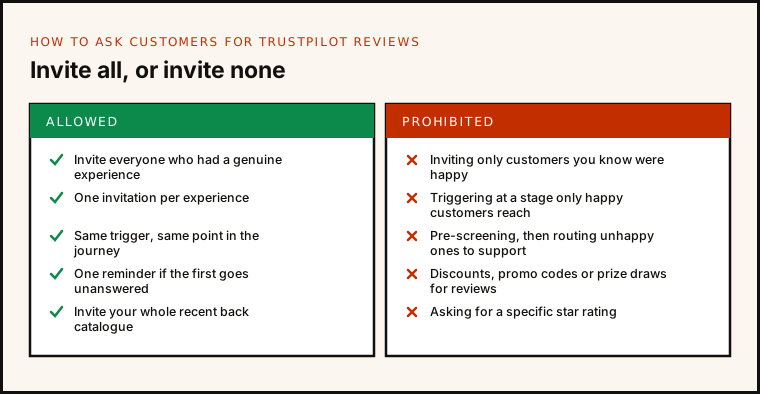
That third one deserves attention because it's sold as a legitimate tactic by a lot of reputation software. "Ask them how they feel first, and only send the review link to the promoters." That is textbook review gating, it is prohibited, and it is also independently unlawful under consumer protection rules in the US, UK and EU.
The incentive rule is broader than people assume
Prohibited incentives include discounts, promo codes, prize draw entries, refunds, freebies, and any other benefit connected to leaving a review. It applies even when you don't ask for a positive one. A prize draw for "anyone who reviews us" breaks the rule just as cleanly as a fiver for five stars.
What are you allowed to do when asking for reviews?
The permitted version is generous, and most companies never come close to exhausting it:
- Invite everyone who has had a genuine experience, one invitation per experience.
- Invite at the same point in the journey, on the same trigger, regardless of how the experience went.
- Send a reminder if the first invitation goes unanswered.
- Ask in person, on packaging, in your signature, on the thank-you page, as long as the ask is neutral and available to everyone.
- Invite your back catalogue of recent customers, so long as you invite all of them and not a hand-picked list.
Notice what's actually being restricted here: not the volume of asking, but the bias of asking. You can be relentless. You just have to be even-handed.
4. The five invitation methods, ranked
Trustpilot has progressively moved the platform toward automated invitations, on the reasoning that automatic triggers considerably reduce the ability to manipulate who gets asked. Manual entry of individual customer emails has been sunset. So the practical choice is between four automated routes and one non-email route.
| Method | Setup effort | Control | Best for |
|---|---|---|---|
| 1. Native integration Shopify, WooCommerce, Magento, BigCommerce, Klaviyo, HubSpot, Zendesk and others |
Low (minutes) | Medium | Almost everyone. Start here. |
| 2. Automatic Feedback Service (AFS) BCC your unique Trustpilot address on a transactional email |
Low (one field) | Medium | Any platform with no native integration. The universal fallback. |
| 3. AFS + structured data snippet Adds hidden structured data to the triggering email |
Medium (needs a developer) | High | Multi-language, product reviews, precise reference IDs. |
| 4. Invitations API Fire service and product review invitations programmatically |
High (developer build) | Highest | Custom stacks, complex trigger logic, marketplaces. |
| 5. Company API link / review collector A plain link or widget to your profile |
Lowest | Low | Email signatures, packaging inserts, receipts. Supplementary only. |
How does the Trustpilot Automatic Feedback Service work?
AFS is the workhorse, so it's worth understanding. Trustpilot gives your account a unique email address. You add that address to the BCC field of a transactional email you already send, usually the order confirmation or dispatch note. When that email goes out, Trustpilot receives a copy, extracts the recipient, and schedules an invitation according to your settings.
You'll find your unique address under Collect reviews → Invitation methods → Automatic Feedback Service in the Trustpilot business app. From the basic setup you control sender name, language, invitation timing and frequency.
By default, AFS pulls names and reference IDs from email subject lines to personalise invitations. If you want more control (localised landing pages, product review invitations, cleaner reference data), you add a structured data snippet to the triggering email. That needs a developer, but it's an hour of work, not a project.
5. How to set up automatic Trustpilot review invitations
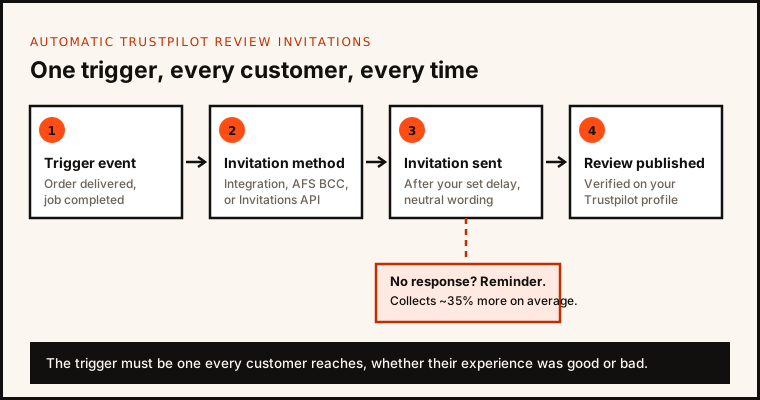
Seven steps, roughly 45 minutes if your platform has a native integration. Do them in order. Step two is the one people skip, and it's the one that gets profiles warned.
Step 1: Claim and verify your profile
Claim the business profile and complete verification: proof of identity, contact details, domain. Verification matters beyond vanity. Your public transparency page shows what you've confirmed, and an unverified profile with a sudden surge of reviews is exactly the pattern fraud detection is built to catch.
Step 2: Pick one trigger event, and pick it honestly
Choose a single transactional moment that every customer reaches. Good triggers: order delivered, service completed, subscription renewed, support ticket closed. Bad triggers: "customer left a positive NPS score," "customer reordered," "customer didn't contact support." Those last three quietly filter for satisfaction, which is the violation.
A useful test: could an unhappy customer reach this trigger? If the honest answer is no, pick a different trigger.
Step 3: Connect an automated method
Check the Trustpilot integrations directory for your platform first. If it's listed, use it: you'll get order data mapped cleanly and product review support without custom work. If it isn't, grab your AFS address and BCC it on the trigger email. For custom stacks, use the Invitations API, which handles both service and product review invitations from a single call.
Step 4: Set the delay, then set the reminder
The delay should match when the customer has genuinely experienced what they bought. Asking a furniture buyer on dispatch day gets you a review about the checkout page. Asking three days after delivery gets you a review about the sofa. Timing guidance by business type is in section 7.
Then turn on the reminder. Trustpilot reports reminder emails collect an additional 35% more reviews on average, the highest-ROI toggle in the entire product, and it's one click.
Step 5: Brand the template, keep the wording neutral
Customise sender name, logo, colours and copy so the invitation looks like you rather than like Trustpilot. Templates are available in 16 languages. What you must not do is steer: no "if you loved it, leave us five stars," no "we're aiming for a perfect score." Ask for the experience, not the rating.
Step 6: Test with a real order, then check deliverability
Put a genuine order through the flow using an address you control. Confirm the invitation arrives, arrives in the inbox rather than promotions or spam, renders on mobile, and links to the right profile. Then check your sending domain's SPF, DKIM and DMARC records. A review invitation that lands in spam is invisible, and this is the most common cause of "we set it up and nothing happened."
Step 7: Invite the back catalogue across 90 days
Your automation only touches customers going forward. The people you served last quarter are still reachable, and inviting them is the fastest way to build the recent-review base the score cares about. Trustpilot recommends inviting past customers across a 90-day window after setting up automated invitations.
Two constraints: invite all of the recent cohort, not a curated slice, and stagger the sends. Dumping 3,000 invitations in one afternoon produces a volume spike that looks exactly like a bought batch, and Trustpilot applies undisclosed adjustments for suspicious patterns.
We build this once, properly, and then it just runs.
Most companies get through step three and stall: the integration half-works, invitations land in spam, and six weeks later nobody has checked. We do the whole build and then run it as a monthly programme.
- Invitation architecture: trigger design, integration or API build, deliverability
- Back-catalogue campaign, staggered so it reads as organic growth
- Reply handling on every review, negative ones inside 24 hours
- Monthly reporting on volume, rating movement and what customers actually complained about
6. Five Trustpilot review invitation email templates
Paste these, swap the bracketed fields, and keep them neutral. Every one of them asks about the experience rather than the rating. That's not squeamishness, it's the rule. Subject lines are included because roughly half your open rate is decided there.
Subject: How did the [product] work out?

Hi [First name],

Your [product] was delivered a few days ago, so you've had a chance to
actually use it by now.

Would you take two minutes to write about how it's going? Good or bad, we
read all of it, and it's the main way other people work out whether
we're worth buying from.

[Leave a review →]

Thanks,
[Name]
[Company]
Subject: Your feedback on the [service] we did

Hi [First name],

We finished the [service] at [location/date]. Before it fades from
memory, we'd like to know how it went from your side.

It takes about two minutes, and it goes on our public profile, so
please be honest. If something wasn't right, we'd rather hear it
than not.

[Write your review →]

Best,
[Name]
[Company]
Subject: Two minutes on how [product] is going?

Hi [First name],

You've been using [product] for [time period] now, which is long enough
to have an opinion.

We'd like it in public. A short review helps other teams work out
whether this is the right tool for them, and tells us where we're
falling short.

[Review [product] →]

Cheers,
[Name]
[Company]
Subject: Still got two minutes?

Hi [First name],

We asked last week how your [product/service] went. No pressure if
you'd rather not, but if you've got two minutes, it genuinely helps.

[Leave a review →]

Thanks either way,
[Name]
[Company]
Subject: A quick favour, [First name]?

Hi [First name],

You bought from us back in [month]. We've started collecting reviews
properly and we're going back through everyone we've served this year,
you included.

If you've got two minutes to say how it went, we'd appreciate it.
Whatever the verdict.

[Leave a review →]

Thanks,
[Name]
[Company]
Phrases to delete on sight
If any of these are in your invitation, take them out before you send another one:
- "If you were happy, leave us a 5-star review"
- "We're aiming for five stars, help us get there"
- "Leave a review and get 10% off your next order"
- "If anything went wrong, reply to this email instead of reviewing"
That last one is the sneaky one. It reads like good customer service and it functions as review gating: it routes dissatisfaction away from the public profile. You can absolutely offer a support route. Just offer it to everyone, in the same email, alongside the review link, not instead of it.
7. When to send: timing windows by business type
Send too early and you get a review about your checkout page. Send too late and the customer has forgotten you exist. The right delay is the moment the customer has enough experience to have a real opinion, plus a day.
| Business type | Trigger | Delay | Reminder |
|---|---|---|---|
| Fast-moving consumer goods | Delivered | 2–3 days | +4 days |
| Apparel & footwear | Delivered | 5–7 days (past the returns decision) | +5 days |
| Furniture, appliances, high-consideration | Delivered | 10–14 days | +7 days |
| Home services (trades, cleaning, repair) | Job marked complete | Same day – 24 hrs | +3 days |
| Professional services | Engagement closed | 3–5 days | +7 days |
| SaaS & subscriptions | Activation milestone or day 30 | Immediate on trigger | +7 days |
| Travel & hospitality | Check-out / return date | 1–2 days | +4 days |
| Financial & insurance | Policy issued or claim closed | 2–4 days | +7 days |
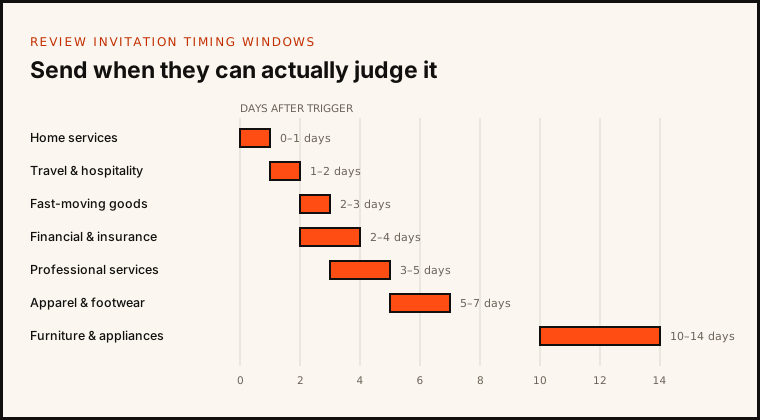
Two adjustments worth making. First, if you sell products with a return window, send after it closes, because reviews written mid-deliberation skew negative and unstable. Second, if you have a slow onboarding, trigger on the activation milestone rather than the purchase date, because a customer who hasn't yet got value will write a review about not yet having value.
8. How to increase your Trustpilot rating
Most people asking how to increase their Trustpilot rating are really asking about the average. Given the weighting model, there are exactly four levers, and only one of them is about the average at all.
Lever 1: Increase recent volume
Because recency dominates, a concentrated run of fresh reviews shifts the average faster than the same number spread over two years. A profile sitting at 3.9 across 300 reviews in the last twelve months that adds 300 more at 4.3 will move. Not to 4.3, but visibly, and within weeks. The lever isn't total review count. It's the composition of the recent window.
Lever 2: Raise the average of what's incoming
This is the one people skip, and it's the only one that isn't a marketing problem. If your incoming reviews average 3.6, no amount of volume produces a 4.5 profile. Read the last fifty reviews, cluster the complaints, and fix the top two. It is almost always delivery times, a support response gap, or one product line that under-delivers.
Lever 3: Never stop collecting
Time decay cuts both ways. A profile that collected hard for a quarter and then stopped will watch its score drift toward neutral as the good reviews age out of the weighted window. Consistency isn't a nice-to-have; it's structural.
Lever 4: Recover the recoverable one-stars
Reviewers own their reviews and can edit or delete them at any time. A well-handled complaint sometimes becomes an edited review. See section 10 for the framework, but note the mechanic here, because a converted one-star is worth roughly double a new five-star: it removes a drag and adds a lift.
9. Why your Trustpilot reviews aren't showing
A customer tells you they left a glowing review and it isn't there. Before assuming the platform is broken, work down this list. The cause is almost always in the top four.
| Cause | How to tell | Fix |
|---|---|---|
| Reviewer never confirmed their email | Most common by far. Every review is tied to a user account with a valid email address. | Ask them to check for the confirmation email, including spam. |
| Caught by automated fraud detection | Often after a volume spike, VPN use, or several reviews from one IP or device. | Stagger invitations. If it's a false positive, contact Trustpilot support with the order reference. |
| Breaches the guidelines | Named staff, personal data, promotional content, abusive language, or no genuine experience. | The reviewer can edit and resubmit. You cannot edit it for them. |
| Reviewer deleted or edited it | Reviews are owned by the reviewer, who can edit or delete at any time. | Nothing to fix. This is by design. |
| You're on a filtered or localised view | Country subdomains and active filters change what's displayed. | Clear filters and check the main profile. |
| It's under investigation after a flag | Flagged reviews stay visible during investigation, except those flagged as harmful or illegal, which are hidden or blurred while reviewed. | Wait for the outcome. |
Why are my Trustpilot review invitations not sending?
Different problem, different checklist. In order of likelihood: the BCC address was removed during a template update; the trigger email stopped firing; the sending domain's authentication broke and invitations are going to spam; the integration's authorisation token expired; or the invitation delay is longer than you remember and they're queued rather than missing.
Set a monthly reminder to send one live test order through the flow. Review programmes fail silently. The emails just stop, and nobody notices for a quarter because there's no error message anywhere.
10. How to respond to negative Trustpilot reviews
Knowing how to respond to negative reviews matters more than most owners expect, because your replies are read by far more people than the reviews themselves, because prospective customers filter to one-star specifically to see how you behave under pressure. A negative review with a good reply is a stronger trust signal than no negative review at all.
You cannot delete reviews and you cannot pay to have them removed. What you can do is reply well, and flag the genuinely rule-breaking ones.
What should you say in a reply to a negative review?
- Acknowledge the specific thing. Not "we're sorry you had a poor experience", but "you waited nine days for a dispatch that should have taken two."
- Explain briefly, without excusing. One sentence. What happened, no supply-chain essay.
- State what you're doing about it. For them, and structurally so it doesn't recur.
- Give a named route out of public. A person and an email address, not "contact customer services."
Hi [Name],

Nine days for a dispatch that should have taken two isn't acceptable,
and you were right to say so publicly.

Your order was caught in a warehouse migration we handled badly. That's
on us, not the courier.

I've refunded your delivery charge today, and we've moved the migration
backlog to a separate queue so nothing else sits behind it.

If you want it sorted further, email me directly at [name]@[company].com
and it comes straight to me.

[Name], [Role]
Then, once it's genuinely fixed, you may ask the reviewer to reconsider. Ask them to update their review to reflect what happened, never to remove it, and never in exchange for anything, which would make it an incentivised review.
When should you flag a Trustpilot review instead of replying?
Flag a review when it breaches the guidelines: no genuine experience with your business, personal data, harmful or illegal content, promotional spam, or a review from a competitor or someone with a special relationship to a business. Trustpilot's Content Integrity Team assesses it, contacts the reviewer where there's a breach, and removes the review if the reviewer can't resolve it.
Your flagging record is public
Every profile has a Company Activity page showing how many reviews the business flagged, how often, the star distribution of what they flagged, and what share of those flags turned out to be invalid. A profile showing "flagged 14 reviews, 100% of cases invalid, all of them one-star" tells a prospective customer everything. Flag the rule-breakers. Don't flag the ones that just sting.
Reply to positives too, briefly. A profile where every review has a reply reads as a company that's paying attention. It also nudges reviewers who see the reply notification to come back and update as things change.
11. Trustpilot review generation strategy for ecommerce
A Trustpilot review generation strategy for ecommerce has the highest ceiling of any sector, because the transaction data is clean and the volume is there. Five things separate the stores that get this right.
Run service and product reviews as one system
Service reviews sit on your company profile and drive the TrustScore. Product reviews attach to individual SKUs and can feed rich results and shopping surfaces. The Invitations API and the structured data snippet can trigger both from a single order event, so build them together rather than bolting product reviews on a year later.
Should you trigger the invitation on dispatch or on delivery?
Wiring the invitation to your carrier's delivered webhook rather than your own dispatch confirmation is the single highest-value engineering change most stores can make. It aligns the ask with the moment the customer has the thing, and it removes the review-about-checkout problem entirely.
Segment the delay by category, not by customer
Category-based delays are fine: a mattress reasonably gets a longer window than a phone case. Customer-based delays are not, because they let you time the ask around who you expect to be happy. Segment the product, never the person.
Put the score where the doubt is
Reviews you don't display do nothing for conversion. The three places that matter: the product page near the add-to-cart, the cart, and the checkout. That's where hesitation lives. A TrustScore in the footer is decoration.
Treat seasonal peaks as a collection opportunity
Q4 gives you your largest cohort of the year and, usually, your worst delivery performance. Keep the invitations running anyway. The instinct to pause collection during a bad delivery stretch is understandable and it's also selective inviting by another name, and it costs you the volume that would have absorbed the damage.
12. Why buying Trustpilot reviews ends profiles
Plenty of people searching how to get more Trustpilot reviews end up searching how to buy Trustpilot reviews instead. The demand is real and there's a whole industry serving it. Here is why it's a bad trade even setting aside the ethics.
It's illegal in your three biggest markets
- United States: the FTC's Rule on the Use of Consumer Reviews and Testimonials (16 CFR Part 465) bans buying, selling and procuring fake reviews, with civil penalties assessed per violation.
- United Kingdom: the DMCC Act 2024 makes commissioning and publishing fake reviews a banned practice, enforceable directly by the CMA with fines up to 10% of global turnover.
- European Union: the Omnibus Directive amendments to the Unfair Commercial Practices Directive prohibit submitting or commissioning false reviews across all member states.
The platform is built to catch it
Trustpilot runs automated fraud detection alongside a human Content Integrity Team, and applies undisclosed score adjustments for suspicious patterns such as sudden volume spikes and suspected fake clusters. Enforcement escalates: a warning, then a formal notice that restricts platform interaction, then account suspension or a public consumer warning banner on your profile.
That banner is the part people underestimate. It doesn't quietly reduce your score. It appears at the top of your profile, telling every visitor that Trustpilot found evidence of misuse, on the page your brand-name searches lead to.
The exposure outlives the agency
Purchased reviews get removed, so the score reverts. The paper trail doesn't. Invoices, order records and the vendor's own client list are all discoverable, and a business that bought reviews in 2024 can be enforced against in 2027. Whoever sold them to you will not be sharing the penalty.
What AdsTicket won't sell
We don't sell reviews, we don't write reviews, and we don't build gated flows that route unhappy customers away from your profile. If that's what you're shopping for, we're the wrong agency and we'd rather say so on this page than on a call. What we do sell is the system that gets you the reviews you've already earned.
13. Your first 30 days
Here is how to get more Trustpilot reviews starting from a standing start: a build sequence you can hand to someone. Nothing here needs a budget beyond the platform.
Week 1: Foundation
- Claim and verify the profile; complete every verification field.
- Read your last fifty reviews and write down the top three complaint clusters.
- Pick your trigger event and apply the "could an unhappy customer reach this?" test.
- Reply to every unanswered review, oldest negatives first.
Week 2: Build
- Connect the native integration, or set up AFS with your unique BCC address.
- Set the delay using the timing table in section 7.
- Turn on the reminder.
- Brand the template and strip out any steering language.
- Send a live test order through the whole flow. Check SPF, DKIM and DMARC.
Week 3: Backfill
- Export every customer from the last 90 days. All of them.
- Stagger invitations across the week: a few hundred a day, not thousands at once.
- Add the review link to your email signature, packaging insert and thank-you page.
- Place the TrustScore widget on product page, cart and checkout.
Week 4: Operate
- Set a 24-hour reply SLA on negatives, 72 hours on everything else.
- Fix complaint cluster number one. Actually fix it.
- Record baseline metrics: review count in the last 12 months, current average, current TrustScore.
- Diarise a monthly live test order so the flow never fails silently.
Then leave it alone and let it compound. The programme that works is boring: the same invitation, on the same trigger, to everybody, forever. Companies that treat review collection as a campaign get a spike and a slow decline. Companies that treat it as plumbing get a number that climbs quietly for years.
Or hand the whole thing to us.
Fixed scope, fixed monthly price, three-month minimum. Your Trustpilot profile stays in your name. Leaving costs you a password change, not a quarter.
- Full invitation build: trigger design, integration or API, deliverability, templates
- Staggered back-catalogue campaign across your recent customers
- Every review replied to; negatives inside 24 hours
- Monthly report on volume, rating movement and the complaints worth fixing
- No bought reviews, no written reviews, no gating. Ever.
14. Frequently asked questions
How do I get more Trustpilot reviews?
Send an automated review invitation to every customer on the same trigger event, at the same point in the journey. Add one reminder email, invite your back catalogue over 90 days, and keep the flow running continuously. Consistent volume, not one-off pushes, is what raises a TrustScore.
Can you buy Trustpilot reviews?
No. Buying reviews breaks Trustpilot's guidelines and is illegal under the FTC's fake reviews rule in the US, the DMCC Act in the UK and the Omnibus Directive in the EU. Trustpilot removes purchased reviews, can place a public consumer warning on the profile, and its transparency page shows how many reviews a business flagged and how many of those flags were invalid.
How long does it take to raise a Trustpilot rating?
For businesses with under 10,000 reviews the TrustScore recalculates immediately after each new review, but visible movement depends on volume. A profile with 50 recent reviews can move within days. A profile with several thousand needs sustained volume over months, because each new review is a smaller share of the weighted average.
Why are my Trustpilot reviews not showing?
Common causes are the reviewer never confirming their email address, the review being caught by automated fraud detection, a guidelines breach, the reviewer deleting it themselves, or you looking at a filtered or localised version of the profile. Reviews flagged by a business stay visible during investigation unless they were flagged as harmful or illegal.
Are invited Trustpilot reviews worth less than organic ones?
No. Trustpilot states that its TrustScore calculation does not distinguish between verified, invited and unprompted reviews, and that review source does not affect a review's weight. Invited reviews go through the same fraud detection and moderation as any other review.
Can I offer a discount for a Trustpilot review?
No. Incentivised reviews are prohibited. That covers discounts, promo codes, prize draw entries, refunds, freebies and any other benefit connected to leaving a review. It applies even if you don't ask for a positive review in return.
Can a business delete a bad Trustpilot review?
No. Businesses cannot delete reviews and cannot pay to have them removed. You can flag a review that breaches the guidelines, and Trustpilot's Content Integrity Team decides the outcome. Your flagging volume and the share of flags found invalid are published on your public transparency page, so weak flags are visible to anyone who looks.
How many Trustpilot reviews do I need before the score looks credible?
Every new profile starts with seven neutral 3.5-star reviews built into the calculation, so early reviews are heavily damped. Around 50 recent reviews is where a profile starts reflecting real performance, and a few hundred within a rolling 12 months makes the score stable against a single bad week.
How do I get my first 100 Trustpilot reviews?
Set up automated invitations first, then invite every customer from the last 90 days in staggered batches rather than one send. For most businesses that back catalogue is large enough to clear 100 on its own, because typical invitation response rates land in the low double digits. Keep the automation running afterwards so the number keeps climbing without further effort.
Can I ask for a Trustpilot review in person or on packaging?
Yes. Verbal requests, packaging inserts, receipts, email signatures and thank-you pages are all fine, because they're available to every customer rather than a selected few. What you cannot do is decide who gets asked based on how happy they seem, or attach any benefit to leaving the review.
Does replying to Trustpilot reviews improve your rating?
Not directly. Replies don't factor into the TrustScore calculation. They matter for two other reasons: prospective customers filter to one-star reviews specifically to read how you respond, and a well-handled complaint sometimes leads the reviewer to edit their review, which does move the score.
Should I ask for reviews on Trustpilot or Google first?
They do different jobs. Google reviews feed local search and the map pack; Trustpilot feeds brand-name searches, seller ratings and third-party trust signals on your own site. If you're a local service business, start with Google. If you sell nationally or online, start with Trustpilot. Either way the same rule applies to both: invite everyone, on the same trigger, with no incentive.
15. Sources
Every platform mechanic in this guide comes from Trustpilot's own published documentation rather than third-party summaries, which disagree with it on several points. The legal claims come from the regulators directly.
- TrustScore and star rating explained Trustpilot Help Centre · recency, frequency, the seven-review anchor, and confirmation that review source does not affect weight
- Guidelines for Businesses Trustpilot · selective inviting, incentives, flagging, and enforcement actions
- Guidelines for Reviewers Trustpilot · incentivised reviews, special relationships, review ownership
- How Trustpilot works Trustpilot · invited reviews face the same moderation, and the prohibition on cherry-picking
- Automatic Feedback Service FAQ Trustpilot Help Centre · BCC setup, structured data snippets, timing controls
- Send invitations using a Trustpilot API Invitation Trustpilot Help Centre · service and product review invitation endpoints
- Rule on the Use of Consumer Reviews and Testimonials US Federal Trade Commission · 16 CFR Part 465