How do you run ads for forex?
To run ads for forex: clear the licensing gate for every country you target, build an offer that isn't "trade with us", test six creative angles against a broad audience, and optimise toward funded accounts rather than leads. Creative carries the entire test, because Special Ad Category takes your audience targeting away.
- Clear the gates in parallel with creative production, not after it.
- Name a mechanism. Spreads, execution, funding speed or tooling. Never "trading".
- Test angles before formats. Six angles, one creative each, equal budgets.
- Put the risk warning in ad text, never burned into the image.
- Send traffic to a page, not a DM. Telegram routing is prohibited and it kills accounts.
- Feed deposits back through the Conversions API so you optimise to money, not form fills.
- Scale 20–30% every three days. Faster reads as a spike and gets the estate reviewed.
Key takeaways
- Creative is the only variable you still control. Special Ad Category strips detailed targeting, so six angles beats six audiences every time.
- Cheap leads are the trap. Optimise to funded accounts or you will scale a campaign that fills the CRM and empties the P&L.
- The offer is the lever, not the hook. If a competitor can say your sentence word for word, you don't have an offer.
- Compliance is a speed advantage, not a tax. Two weeks of paperwork up front beats rebuilding an estate every quarter.
- Never route investment leads to Telegram or WhatsApp. Meta prohibits it outright, and it is the most common reason a "working" forex funnel loses the account.
- Enforcement lands on the asset, not the ad. One careless campaign can take the Business Manager, the pages and the admins with it.
- An agency can run client ads from its own verified BM, with a separate ad account per client and the relationship declared to Meta.
Most people writing about how to run ads for forex are selling ad accounts. That tells you what their advice optimises for: churn. Buy an account, burn an account, buy another one.
This is the operator version of how to run ads for forex. Offer construction, creative angles that pass review and still convert, campaign architecture, a 14-day test that finds a winner, and the unit economics that tell you whether to scale or stop.
The compliance material is here too, compressed into two weeks of work in section 2. Not because it's interesting. Because it's the difference between a channel and a treadmill.
1. Why most forex ad accounts die in the first week
Ask ten people how to run ads for forex and nine will talk about creative. It is almost never the creative. It is the sequence.
The pattern is so consistent you can set your watch by it. A new Business Manager gets spun up on Monday. Authorization is pending, or missing entirely for half the target countries. Creative goes live with a profit hook because that is what the last agency ran. Budget jumps from $200 to $2,000 inside 48 hours because the first day looked good. By Thursday the ad account is gone, and because Meta enforces at asset level, the Business Manager and the pages went with it.
Nothing in that sequence is a creative problem. Every step of it was decided before a single impression served.
| The account that dies | The account that runs for three years |
|---|---|
| Launches while authorization is pending | Launches the week after authorization clears |
| Targets 12 countries on one licence | Targets the countries on the licence map, and no others |
| Profit hooks, because they worked in 2019 | Mechanism hooks, because they pass and still convert |
| $200 to $2,000 in 48 hours | 20–30% every three days |
| Leads to a Telegram group | Leads to a landing page with a real form |
| Optimises to lead volume | Optimises to funded accounts |
| Buys a replacement when it dies | Never needs one |
Read the right-hand column again. None of it is clever. That is the point: this vertical does not reward cleverness, it rewards sequence. The operators still standing after three years are running boring campaigns on accounts that were set up properly once.
2. Clear the three gates in two weeks
This is the part everybody skips and everybody pays for. Do it in parallel with creative production, so week three is a launch rather than a wait.
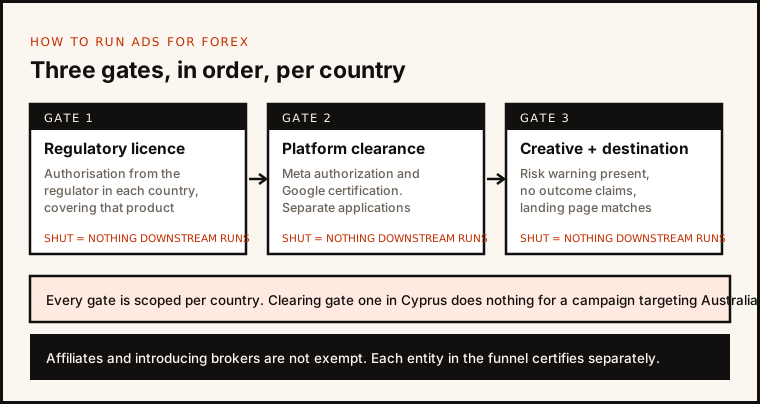
Gate one: the licence map (half a day)
One row per target country. Regulator, licence number, products covered. Blank row means that country leaves the media plan. That is the entire exercise, and it takes an afternoon, and skipping it is the single most expensive decision in this vertical.
Gate two: platform clearance (one to three weeks, running in background)
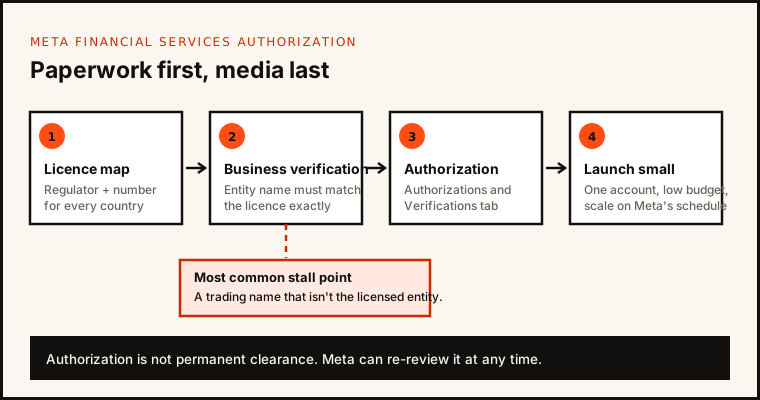
Meta. Verify the business, then submit financial services authorization through Authorizations and Verifications in Business Suite. The documents must match the licensed entity name exactly. Not the trading name, not the holding company. A comma out of place costs a fortnight.
Google. The category is complex speculative financial products, covering CFDs, rolling spot forex and spread betting. Certification is per location, and it now lives in-account under Admin → Policy → Account. Certified ads serve as "Eligible (limited)": permission to operate in a reduced envelope, not a return to normal.
One thing that catches people running affiliate or IB traffic: Google does not exempt affiliates, comparison pages, "best broker" rankings or signal destinations. Every entity in the funnel certifies separately, for every location.
Gate three: what the ad may say (ongoing)
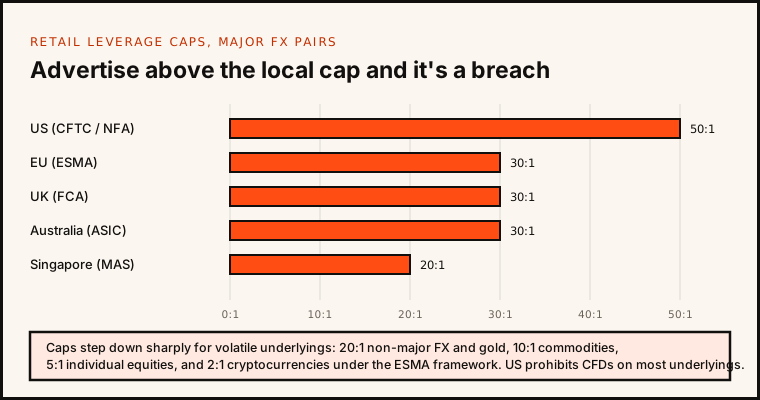
Two hard numbers to know before writing copy, because they constrain what you can claim.
| Regime | Max retail leverage, majors | Deposit bonus | Risk warning in ad |
|---|---|---|---|
| EU / UK | 30:1, down to 2:1 on crypto | Banned | Firm-specific loss %, mandatory |
| Australia | 30:1, 2:1 on crypto | Restricted | General advice warning |
| US | 50:1 majors, 20:1 minors | Registration-dependent | Required disclosures |
| Singapore | Around 20:1 | Restricted | Required disclosures |
In the EU and UK the warning is firm-specific: the percentage of your retail accounts that lost money over the trailing 12 months, recalculated quarterly. Regulators put the industry range at 74% to 89%, which is the number your prospect has already seen on every competitor's site.
Most advertisers treat that as a wound. Section 3 treats it as the opening.
We clear the gates while you build the creative.
Two weeks of paperwork, done once, properly. Then you launch on an estate that does not need replacing every quarter.
- Licence map, business and domain verification against the entity that actually holds the licence
- Meta authorization and Google certification submitted per market, tracked to approval
- BM, page, pixel and ad account structure with clean ownership and audited access
- Spend limit progression and appeals filed with the business context attached
- Your own verified BM, or a dedicated ad account in ours with the relationship declared to Meta
3. Build the offer before you build the ad
Everything else in this guide is mechanics. This section is the part that decides whether the mechanics are worth running. Take your best-performing ad, delete the logo, and hand it to your closest competitor. Can they run it unchanged?
If yes, you do not have an offer. You have a banner.
Almost every forex ad sells the same abstraction: trade with us. Tight spreads, fast execution, award-winning platform. Every broker says it, which means it carries no information, which means the only lever left is price and the only outcome is a bidding war on CPL.
What makes a real offer in forex advertising?
An offer names a mechanism: a specific, checkable thing you do that the reader can picture, and that a competitor would have to lie to copy.
| Not an offer | An offer |
|---|---|
| "Tight spreads" | "Raw spreads from 0.0 on EURUSD, commission shown on every ticket" |
| "Fast execution" | "Average fill in under 40ms, published monthly with the slippage report" |
| "Easy withdrawals" | "Withdrawals processed same business day, or we credit the fee" |
| "Trusted and regulated" | "Segregated client funds, negative balance protection, licence number on every page" |
| "Trade 200+ instruments" | "Full API access on a live account from day one, no minimum volume" |
Notice what the right column has in common. Every one is falsifiable. A number, a timeframe, a guarantee, a document. Falsifiable claims convert because the reader has been lied to by three brokers already and has stopped reading adjectives.
Why is "regulated" your strongest offer, not your disclaimer?
Your prospect's most vivid memory of this category is probably a withdrawal that did not arrive. That is the actual objection, and it is not price.
Segregated funds, negative balance protection, a named regulator and a licence number answer it directly. Most brokers bury that in the footer because it feels like compliance furniture rather than marketing. It is the single most under-used converting asset in the vertical, and it happens to be one of the few strong claims you are allowed to make.
4. Nine angles that survive review and still convert
Angles are not hooks. An angle is the argument; a hook is the first three seconds. Get the angle list right and the hooks write themselves.
| # | Angle | Example opening line |
|---|---|---|
| 1 | Cost transparency Fees are the category's trust wound | "Here is every fee we charge, on one page. There is no sixth line." |
| 2 | Withdrawal speed The number one category fear | "Withdrawals processed the same business day. Here is last month's average." |
| 3 | Execution proof Verifiable, technical, credible | "We publish our slippage during NFP. Most brokers do not." |
| 4 | Regulatory standing Answers the real objection | "Segregated funds. Negative balance protection. Licence number in the footer of every page." |
| 5 | Platform and tooling Wins experienced traders | "Full API access on a live account from day one." |
| 6 | Switching Targets the already-converted | "Moving broker? Here is what to check before you transfer a balance." |
| 7 | Education Top of funnel, cheapest reach | "What a margin close-out actually does to an open position." |
| 8 | Comparison High intent, needs care | "Spread, commission and overnight financing on EURUSD, side by side." |
| 9 | Onboarding friction Underrated, converts well | "Account verified in under an hour, or we tell you why not." |
Six of these should be in your first test. Not six variations of one, six genuinely different arguments, because you are about to discover that the angle you were sure about is third.
What do all nine angles have in common?
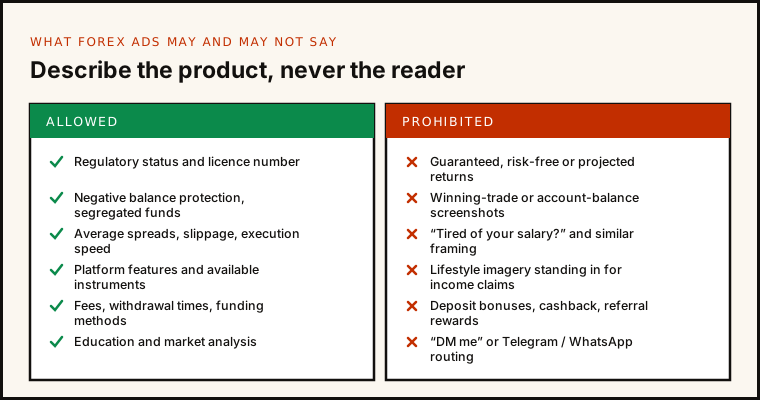
None of them makes a promise about the reader's future. That is the whole rule, and it is worth internalising as a reflex rather than a checklist: every prohibited claim in this vertical is a promise about the reader's outcome. Profit hooks, balance screenshots, lifestyle imagery and "tired of your salary?" all fail the same test.
The personal attributes policy is the one that catches good copywriters, because it fires on implication rather than statement. "Struggling to save?" asserts something about the reader. Enforcement on this tightened through 2026 and now catches framing that passed two years ago.
5. Ad structure: hook, body, proof, CTA
Four parts. Most forex ads have one and a half.
What makes a good hook for a forex ad?
The hook's only job is to stop the scroll of the person you want and let everyone else keep going. In this vertical that means being specific enough to be boring to a non-trader. "0.0 spreads on EURUSD" filters better than "Start trading today", and it filters in the right direction.
- Number-first: "40ms average fill. Published monthly."
- Category-callout: "If your broker won't publish slippage, there's a reason."
- Question of fact: "What does your broker charge to hold EURUSD overnight?"
- Switch trigger: "Moving broker this quarter? Read this first."
The body (2–4 short lines)
State the mechanism, then one consequence. Do not stack three benefits. The ad is not the landing page and the reader is not going to finish it.
The proof (one line, non-negotiable)
A number, a document, a regulator, a published report. This is where compliant advertising quietly beats non-compliant advertising: your competitor's profit screenshot cannot be verified, and yours can.
The CTA and the warning
Put the risk warning in the ad text. Never burned into the image at low contrast, which reduces legibility and gets flagged, and never only on the landing page where the market requires it in the promotion itself.
And send them to a page. Not a DM. Meta prohibits ads promoting investment products that suggest interaction through on-platform or off-platform direct messaging, which covers Telegram, WhatsApp and Messenger. This tactic is recommended constantly in forex marketing content and it is written into policy as prohibited. If accounts keep dying and nobody can explain why, check this first.
Format notes that save a test cycle
- Static beats video for cost and execution angles. A clean fee table outperforms a produced video more often than anyone expects.
- Video wins on education and platform demos, where showing beats telling.
- Talking-head UGC works if the speaker never mentions returns. Constraint kills most scripts, so brief it up front.
- Carousels suit comparison and onboarding-step angles.
- Avoid charts trending up and to the right. It reads as an outcome claim to review, whatever your intent was.
6. Campaign architecture that scales
Special Ad Category takes detailed demographic, behavioural and interest targeting away and curtails exclusions. Advertisers who built their model on interest stacks lose it overnight, and most respond by fighting the constraint.
Do not fight it. The structure that works under the constraint is simpler than what you had before.
How should you structure the ad account?
- One ad account per client or entity. Meta requires it, and it also contains blast radius.
- One pixel per domain, Conversions API connected from day one rather than retrofitted.
- Domain verified from the BM that runs the ads, not shared in from elsewhere.
Campaign level
- Separate campaigns per country group, matching your licence map. This is a compliance boundary that happens to also be a reporting one.
- ABO for testing, CBO for scaling. Equal budgets during the test, or the algorithm picks a winner before you have data.
- One objective per campaign. Leads and traffic in the same campaign teaches the algorithm nothing useful.
Ad set level
- Broad. Country, age 25+, language. That is usually the whole targeting spec, and it outperforms what you would have built manually.
- Creative volume replaces audience segmentation. Under Special Ad Category, creative is the targeting: the person who stops on a fee-table ad is a different person from the one who stops on a platform demo, and Meta will find both.
- 4–6 ads per ad set. Fewer starves delivery, more splits the signal.
- First-party Custom Audiences from funded clients remain your most valuable input. Build lookalikes off deposits, never off leads.
What naming convention should you use?
[Country] · [Objective] · [Angle] · [Format] · [vN]. When an ad is disapproved eight weeks in and you need to know which angle and which market it belonged to, you will not be guessing. Trivial to set up, impossible to retrofit.
7. How to find a winner in 14 days
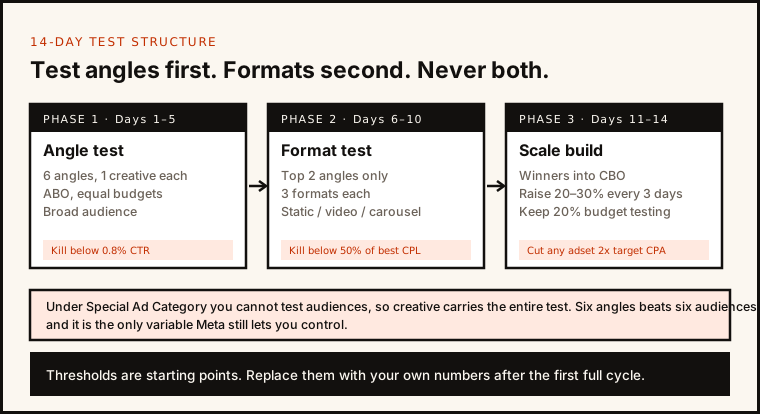
The mistake is testing angle and format at once. Six angles across three formats is eighteen cells, none of which will reach significance on a sane budget, and you will conclude nothing while spending like you concluded something.
Test the argument first. Then test how to say it.
Phase 1, days 1–5: how do you test forex ad angles?
Six angles, one creative each, ABO, equal budgets, one country, broad. Every creative uses the same format so format is not a variable. Budget per ad set should be roughly 3–5× your target CPL, which is the level at which you learn something inside five days.
Kill rule: below 0.8% CTR by day three, it is out. Low CTR here almost always means the argument is wrong, not the image.
Phase 2, days 6–10: the format test
Take the top two angles only. Three formats each: static, video, carousel. Same copy skeleton so the format is the only variable.
Kill rule: anything above 2× the best cell's CPL.
Phase 3, days 11–14: build the scale campaign
Winners move into a CBO campaign. Hold roughly 20% of budget in a permanent testing campaign, because creative fatigue in this vertical is fast and the pipeline has to keep running.
One adjustment worth making: with degraded signal and stripped targeting, the feedback loop is slower and noisier than you are used to. Decisions you would make on three days of data elsewhere need five to seven here. Advertisers who keep their unrestricted-vertical reflexes kill working campaigns early and scale losers fast.
8. The funnel: click to funded account
The ad's job is to produce a click from the right person. Everything after that is where forex campaigns actually fail, because the drop-off between click and funded account is brutal and most advertisers only measure the first step.
| Stage | What kills it | The fix |
|---|---|---|
| Click → page | Slow load, ad-to-page mismatch | Under 2s on mobile. The page must repeat the ad's exact claim above the fold. |
| Page → form start | Generic hero, buried offer | Lead with the mechanism, not the brand. Warning present and legible. |
| Form → submit | Too many fields, or too few | Ask experience, deposit intent and country. Fewer, better leads. |
| Submit → contact | Slow follow-up | Speed to lead is the highest-leverage number in the funnel. Minutes, not hours. |
| Contact → KYC | Document friction, unclear steps | Show the steps up front. Publish the expected time. |
| KYC → funded | Payment method mismatch | Local funding methods per market. This is a market-selection decision, not a checkout one. |
Should the lead form be short or long?
When the platform will not let you qualify before the click, the form has to do it. Asking for trading experience, deposit intent and jurisdiction costs volume and improves everything downstream. That trade is obviously correct when the alternative is paying to acquire people you are not licensed to serve.
Instant forms produce more leads at lower CPL and materially worse quality. Landing pages produce fewer, better ones and give you a place to put the risk warning and the proof. Test both, but judge them on funded accounts, which brings us to the section that matters most.
9. Optimise to deposits, not leads
This is the section that separates a channel that compounds from one that burns.
A campaign optimised to lead volume will find you the cheapest possible form fills. Those people are cheap for a reason. You will watch CPL fall, congratulate the media buyer, scale the budget, and discover a quarter later that cost per funded account went up the whole time.
How do you optimise a forex campaign to deposits?
- Conversions API is mandatory here, not optional. Browser signal on financial domains is degraded and event availability is restricted, so server-side is the only reliable path.
- Send the deposit event back, with value. Optimise to it once volume allows; until then, optimise to the deepest event that fires reliably and reconcile the rest in the CRM.
- Build lookalikes from funded accounts, never from leads. A lookalike of your cheap leads finds more cheap leads.
- Reconcile weekly. Platform-reported and CRM-confirmed numbers will disagree. The CRM is the system of record; the platform is a bidding instruction.
Which number should actually be on the wall?
Not CPL. Cost per funded account, and what a funded account is worth in the first 12 months. Every other metric in this funnel is diagnostic. Those two decide whether you scale. The forex customer acquisition cost guide works the numbers through in full.
10. Scaling without tripping review
Scaling in this vertical is a compliance operation as much as a media one, because the behaviour that looks like growth to you looks like a compromised account to automated review.
- Raise 20–30% every three days. Doubling overnight resets learning and reads as a spike.
- Horizontal before vertical. New angles and new countries on the licence map beat forcing budget through one winning ad set.
- Let spend limits rise on Meta's schedule. The instinct is to open a second account for headroom. That converts a budget problem into an estate problem: multiple low-limit accounts running the same creative is a pattern, and the pattern is what gets actioned.
- Never swap the landing page after approval. Post-approval destination changes are treated as circumvention, which is penalised harder than the original breach would have been.
- Refresh creative before it fatigues, not after. Frequency above ~2.5 on a cold audience is the signal to ship the next batch.
11. What good actually looks like
Be sceptical of anyone quoting you a CPL for this vertical, including us. It swings by market, licence, offer and funnel by more than an order of magnitude, and a single number quoted without those four variables is marketing rather than data.
Ratios travel better than absolutes. These are the ones worth tracking:
| Ratio | What it tells you | Rough read |
|---|---|---|
| Lead → funded account | Lead quality and speed to contact | Falling while CPL falls means you are buying junk |
| Cost per funded ÷ 12-month net revenue per client | Whether the channel is solvent | The only ratio that decides scale up or stop |
| Form start → submit | Form design and offer clarity | Below 40% is a page problem, not a traffic problem |
| CTR by angle, not by ad | Whether the argument lands | Angle-level CTR spread is your creative roadmap |
| Frequency at fatigue point | Creative pipeline pressure | Tells you how many new angles per month you need |
| Approval rate per creative batch | Compliance drift in the copy team | Falling rate means the brief needs rewriting |
Track them for one full cycle, then replace every threshold in this article with your own. Your numbers beat anyone's benchmarks, including the ones on this page.
For the arithmetic behind the scale decision, including a calculator that turns spend, cost per lead and lead-to-funded rate into a scale-or-stop verdict, see forex customer acquisition cost.
12. Why your forex ads keep getting rejected
Work down this list in order. The cause is almost always in the first four.
| Cause | How to tell | Fix |
|---|---|---|
| No valid authorization for that country | Identical creative runs in one market, fails in another. | Check the licence map. Pause the unauthorised markets rather than resubmitting. |
| Personal attributes breach | Copy addresses the reader's financial situation, even as a question. | Rewrite about the product. Delete every "you" statement about money. |
| Missing or illegible risk warning | Absent, or burned into an image at low contrast. | Move it into ad text. |
| Landing page mismatch | Approved ad points somewhere else, or behind a gate. | Match ad to destination. Never swap post-approval. |
| DM routing | Creative or destination pushes to Telegram, WhatsApp or Messenger. | Remove it. Route to a web page. |
| Entity mismatch | Verification name differs from the licensed entity. | Re-verify with documents matching the licence exactly. |
| Behavioural flag | No policy cited; restriction follows a spend spike or new asset. | Scale gradually. Appeal with business context, not a resubmission. |
13. The Business Manager estate underneath all of it
In a vertical where enforcement lands on the asset, structure is a risk control. Most estates fail an audit on the same handful of points.
Who should own the Business Manager?
Two structures are legitimate and Meta documents both. The choice changes your risk profile, not your compliance position.
Client-owned. The broker's verified entity owns the BM, pages, pixels and ad accounts; the agency takes partner access scoped to the ad account. History and audiences stay with the licensed entity, and changing agency costs a permissions edit.
Agency-owned. The agency's verified entity owns the BM and creates a dedicated ad account for the client. Meta supports this directly and provides an "advertise on behalf of another business" designation so the relationship is declared rather than inferred.
Can an agency run client ads from its own Business Manager?
Yes. Meta's Advertising Standards address it directly, and the conditions are specific:
- Verify the agency BM against the agency's own business registration.
- One ad account per client. Meta requires each advertiser or client to be managed through separate ad accounts.
- Never repurpose an ad account. Meta states you must not change the advertiser associated with an established account; set up a new one. This is the rule that catches agencies inheriting accounts when a client leaves.
- Declare the relationship with the on-behalf-of setting.
The agency also carries responsibility for each managed advertiser's policy compliance. In forex that has teeth, because financial services authorization tracks the licensed advertiser, not the Business Manager. An agency BM can run a licensed broker's ads. It cannot make an unlicensed one advertisable.
The rest of the audit
- Two admins minimum, both on the verified entity, both with two-factor. Agencies get scoped partner access, not admin.
- Domain verified from the BM that runs the ads.
- Nothing built on personal profiles or on assets shared in from a previous agency. When that relationship ends, the asset leaves with it.
- A page with a history. An empty page created the week before launch, running regulated promotions at volume, is a weak position to appeal from.
14. What we won't run, and why it matters to you
Most of what ranks for this keyword is written by the account trade: aged Business Managers, pre-verified accounts, rented estates with a spend limit already attached, warming protocols to make a bought account look lived-in.
Be precise about what that is, because it is easy to confuse with the legitimate agency structure above. Creating BMs under your own verified entity and running a client's ads from a dedicated account inside them is supported. Buying, renting or exchanging access to an account somebody else built is prohibited in Meta's own terms.
Three reasons the second one always ends the same way:
- You are buying the thing that gets detected. Review reads account behaviour, not just creative. An asset whose ownership, admins, payment method and traffic pattern change abruptly is displaying the exact signature risk assessment exists to find.
- Circumvention is penalised harder than the original breach. A bad ad loses an ad. Evading enforcement loses the estate and the people attached to it.
- Nothing compounds. No pixel history, no learning, no audience assets, no account trust. Every replacement starts at zero, which is why the model needs ever more accounts to hold volume flat. That is a subscription to account replacement, not a media channel.
And a fourth that is not a platform matter at all: promoting a leveraged product into a market where you are not authorised is a regulatory issue, and in the UK and much of the EU an unauthorised financial promotion is a criminal offence rather than a policy violation. Buying distribution into markets you are not licensed for converts a marketing problem into a legal one.
The short version
We do not buy, rent or sell Business Managers or ad accounts, we do not run cloaked or dual landing pages, and we do not build DM funnels for investment products. If that is the shopping list, we are the wrong desk. What we run is a properly built estate that does not need replacing.
15. Your first 30 days
Here is how to run ads for forex from a standing start. Paperwork and creative run in parallel, so nothing waits on anything.
Week 1: Gates and offer, at the same time
- Build the licence map. Every target country gets a regulator and a licence number, or it leaves the plan.
- Start Meta business verification with documents matching the licensed entity exactly.
- Check whether in-account certification is live under Admin → Policy in Google Ads.
- Write the offer as one sentence. Run it through the three-part test in section 3.
- Pull the trailing-12-month retail loss percentage and confirm who recalculates it quarterly.
Week 2: Creative and instrumentation
- Six angles from section 4, one creative each, same format.
- Every creative through the outcome-claim and personal-attributes test before it goes near the account.
- Risk warning in ad text on every variant.
- Landing page per market, matching the ad's exact claim above the fold.
- Conversions API live. Confirm which events actually fire.
- Submit Meta authorization and Google certification per market.
Week 3: Angle test
- One country, one ad account, ABO, equal budgets, broad targeting.
- Kill on CTR at day three. Do not rescue a losing angle with a new image.
- Log every approval and disapproval with the creative ID. This becomes your compliance brief.
Week 4: Format test and first scale
- Top two angles into three formats each.
- Winners into a CBO campaign, 20% of budget held back for continuous testing.
- Reconcile platform leads against CRM. Record cost per funded account as the baseline.
- Raise budget 20–30% every three days, and let the spend limit rise on Meta's schedule.
Then keep it dull. The advertisers still running in this vertical after three years do not have the cleverest funnels. They have correct paperwork, a real offer, a creative pipeline that never stops, and an account nobody has given review a reason to look at twice.
Or hand the whole thing to us.
Fixed scope, fixed monthly price, three-month minimum. Run it from your own verified Business Manager, or from a dedicated ad account inside ours with the relationship declared. Either way the assets are structured so you can take them with you.
- Licence map, verification, authorization and certification per market, tracked to approval
- Estate audit: ownership, access control, domain, pixel and Conversions API
- Spend limit progression and appeals filed with the business context attached
- Monthly reporting on account health, not just campaign performance
- No bought or rented accounts, no cloaking, no DM funnels. Ever.
Campaign build, creative and daily optimisation is Ticket 01, Meta Ads Management. Most forex advertisers need both, and the estate work has to come first.
14. Frequently asked questions
Can you run forex ads on Facebook?
Yes, but only if you hold a recognised regulatory licence covering each country you target, complete Meta's business verification, and obtain financial services authorization through the Authorizations and Verifications tab in Meta Business Suite. Meta maps each country to its own regulator, so a single licence does not unlock global targeting.
Why do my forex ads keep getting rejected?
The most common causes are missing or invalid authorization for the target country, profit or income claims in the copy, a missing risk warning, a landing page that does not match the ad, and copy that implies knowledge of the viewer's financial situation. Meta's personal attributes policy catches indirect phrasing such as “struggling with your income?” as readily as direct claims.
Do I need a licence to advertise forex as an affiliate or introducing broker?
Yes. Google requires certification for each entity in the funnel, for each location targeted, and explicitly does not exempt affiliates, aggregators, comparison pages or “best broker” rankings. Ad destinations that provide trading signals are covered too. Being one step removed from the broker does not remove the requirement.
What risk warning is required in forex ads?
In the EU and UK, CFD promotions require a standardised risk warning stating the firm-specific percentage of retail investor accounts that lost money over the preceding 12 months, recalculated quarterly. A shortened version is permitted where a platform imposes a character limit, provided the ad links to a page carrying the full warning.
Are binary options ads allowed anywhere?
No. Meta prohibits binary options outright under its Prohibited Financial Products and Services policy, and ESMA banned the marketing, distribution and sale of binary options to retail clients in the EU. There is no certification route that makes them advertisable.
What is the maximum leverage I can advertise?
It depends on the market, and you must respect the local cap in ad content. ESMA capped retail leverage between 30:1 on major currency pairs and 2:1 on cryptocurrencies, ASIC applies a comparable framework in Australia, and US rules limit major pairs to 50:1 with CFDs prohibited on most underlyings.
Can I offer a deposit bonus in a forex ad?
Not to retail clients in the EU, UK or Australia. ESMA's intervention prohibits monetary and non-monetary benefits to retail investors, excluding research and information tools. If a regulated broker is advertising a deposit bonus into those markets, it is either operating through an offshore entity or in breach.
How much budget do you need to test forex ads?
Enough per ad set to produce a decision inside five days, which is roughly three to five times your target cost per lead, multiplied by the six angles you are testing. Testing six angles on a budget that only supports two produces six inconclusive results rather than two clear ones, so cut the angle count before you cut the per-angle budget.
What is a good CPL for forex ads?
There is no portable number. Cost per lead in this vertical swings by more than an order of magnitude depending on market, licence, offer and funnel, so any figure quoted without those four variables is marketing rather than data. Track cost per funded account against 12-month net revenue per client instead. That ratio decides whether to scale; CPL only tells you whether the creative is working.
Should you use instant lead forms or landing pages for forex ads?
Instant forms produce more leads at lower cost and materially worse quality. Landing pages produce fewer, better ones, and give you somewhere to place the risk warning and the proof. Run both, but judge them on funded accounts rather than lead volume, or the instant form will win every report while losing money.
How many creatives do you need to run forex ads?
Six genuinely different angles to start, one creative each, then three formats for the two angles that win. After launch, plan a continuous pipeline rather than a batch: creative fatigue is fast in this vertical, and holding around 20% of budget in a permanent testing campaign is what keeps the scale campaign fed.
Can an agency use its own Business Manager to run client ads?
Yes. Meta's Advertising Standards contemplate managing ads on behalf of other advertisers, and provide an advertise-on-behalf-of designation to declare it. The conditions are that the agency Business Manager is verified against the agency's own business registration, each client is managed through a separate ad account, and an established ad account is never switched to a different client. Selling, renting or exchanging administrative access remains prohibited. For forex specifically, agency ownership does not replace the broker's own regulatory authorisation in each target country.
Why did Meta ban my ad account for forex ads?
Usually because the account ran financial promotions without valid authorization for the target country, used prohibited claims, or showed a pattern automated review treats as circumvention, such as a sudden spend jump on a new asset or a landing page that differs from what was reviewed. Meta can restrict the whole business account rather than the single ad.
Can I send forex leads to Telegram or WhatsApp?
No, not from a Meta ad. Meta's financial services policy prohibits ads that promote investment products or opportunities suggesting user interaction with the advertiser through on-platform or off-platform direct messaging services. This is one of the most common reasons otherwise-compliant forex funnels get accounts restricted.
How long does Meta forex authorization take?
Plan for weeks rather than days, and longer in markets where Meta involves a regional policy team. Business verification comes first and can itself take several days if documents do not match the licensed entity name exactly. Build the timeline into the launch plan rather than booking media against an unapproved account.
Is running forex ads on Google better than Meta?
They do different jobs. Google captures existing intent from people already searching for a broker, and certified ads serve with an “Eligible (limited)” status. Meta creates demand and generally produces cheaper upper-funnel volume, under tighter creative rules and Special Ad Category targeting limits. Most licensed brokers run both, certifying separately on each.
15. Sources
Platform rules here come from Meta's and Google's own policy documentation rather than third-party summaries, which are frequently out of date on this vertical. The regulatory claims come from the regulators.
- Financial and Insurance Products and Services Meta Transparency Center · authorization requirements, the direct-messaging prohibition, and what runs without authorization
- Introduction to the Advertising Standards Meta Transparency Center · managing ads on behalf of other advertisers, separate ad accounts per client, and the prohibition on selling or renting administrative access
- Advertising on behalf of another business in Business Manager Meta Business Help Center · the on-behalf-of designation for agencies and Marketing Partners
- Prohibited Financial Products and Services Meta Transparency Center · binary options, ICOs and short-term loans prohibited outright
- Discriminatory Practices Meta Transparency Center · the Financial Products and Services special ad category and where it applies
- Complex speculative financial products Google Ads Policy Help · scope of the category, and the June 2026 move to in-account applications
- Apply to advertise restricted financial products Google Ads Policy Help · certification scope and the "Eligible (limited)" serving status
- ESMA agrees to prohibit binary options and restrict CFDs European Securities and Markets Authority · leverage caps, margin close-out, negative balance protection, incentive ban, and the 74–89% retail loss finding
- FCA statement on ESMA's product intervention measures Financial Conduct Authority · UK application of the CFD and binary options measures